Space updates · 2026
November
Webb finds clues to a star’s last hours in Cassiopeia A’s dust
Webb distinguished silica-rich and carbon-rich clumps in the supernova remnant Cassiopeia A. Their distribution, together with earlier X-ray evidence, supports a scenario in which layers inside the original star mixed shortly before it exploded.
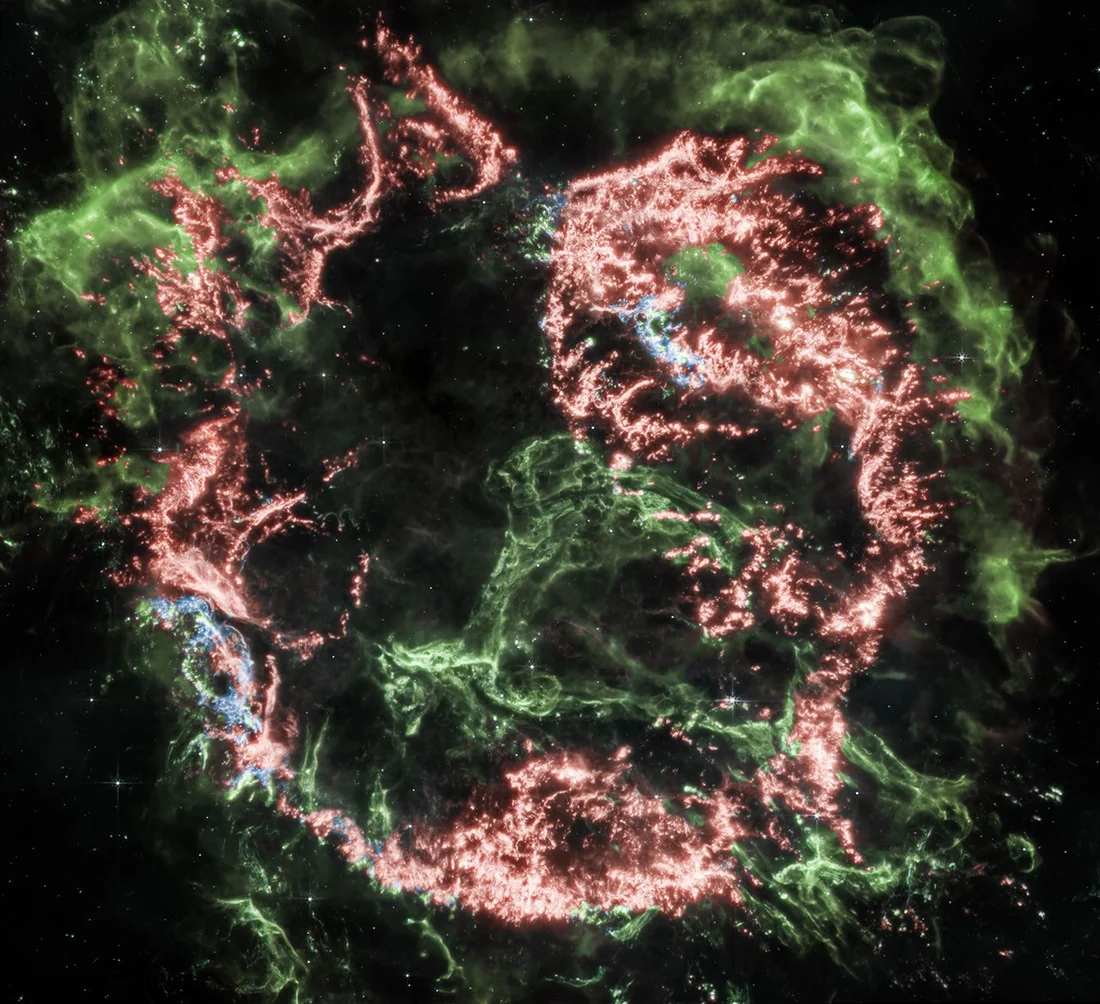
Image: NASA, ESA, CSA, STScI, Tea Temim (Columbia University), Rick Arendt (UMBC), Dan Milisavljevic (Purdue University); Image Processing: Joseph DePasquale (STScI) BepiColombo reaches Mercury orbit
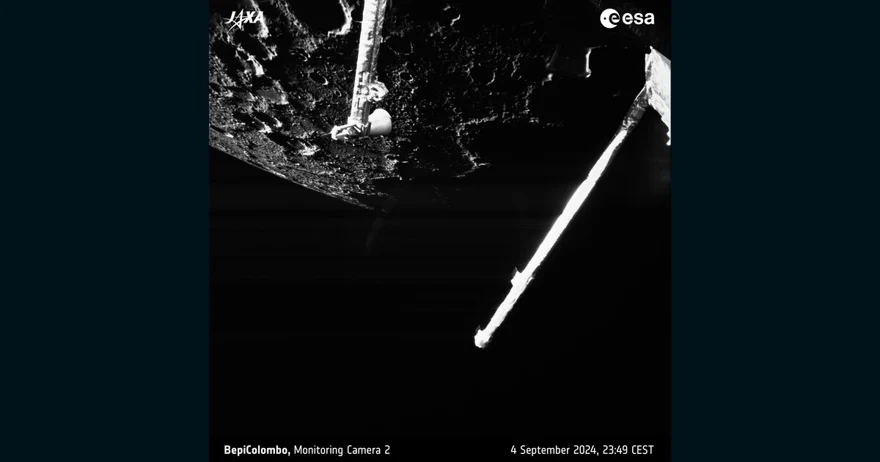
ESA confirmed that the joint European–Japanese mission was captured into orbit around Mercury on 21 November. A software issue cut the engine burn short. The spacecraft is safe, and the flight team is investigating.
Mercury flyby, 2024 · ESA/BepiColombo/MTM Voyager 1 reaches one light-day from Earth
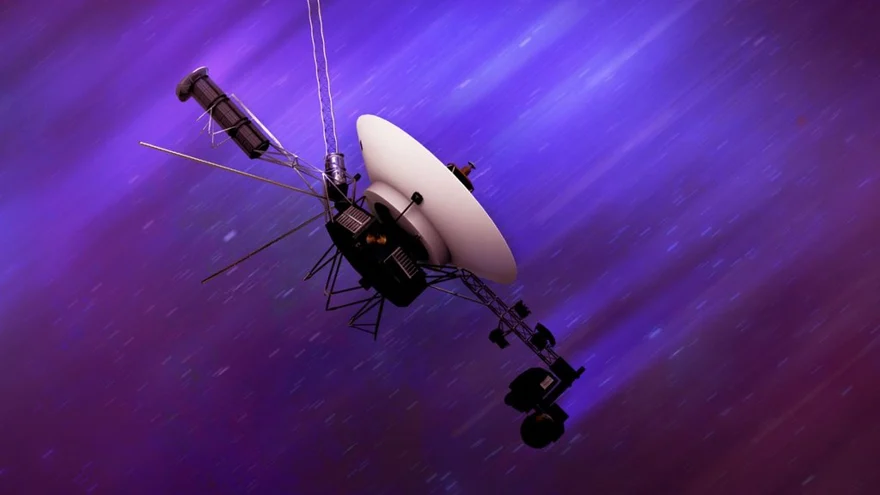
Voyager 1 passed the milestone on 18 November, about 26 billion kilometres from Earth. A radio signal takes roughly 24 hours to travel each way, so a command and its reply take about two days in transit.
Voyager artist’s concept · NASA/JPL-Caltech ESA selects a seven-spacecraft mission to study plasma
ESA member states have selected Plasma Observatory as the agency’s next medium-class science mission. Seven spacecraft will work together to measure particles and electromagnetic fields as the solar wind interacts with Earth’s magnetic environment. Taking measurements on several scales at once will help scientists follow how energy moves through that system.
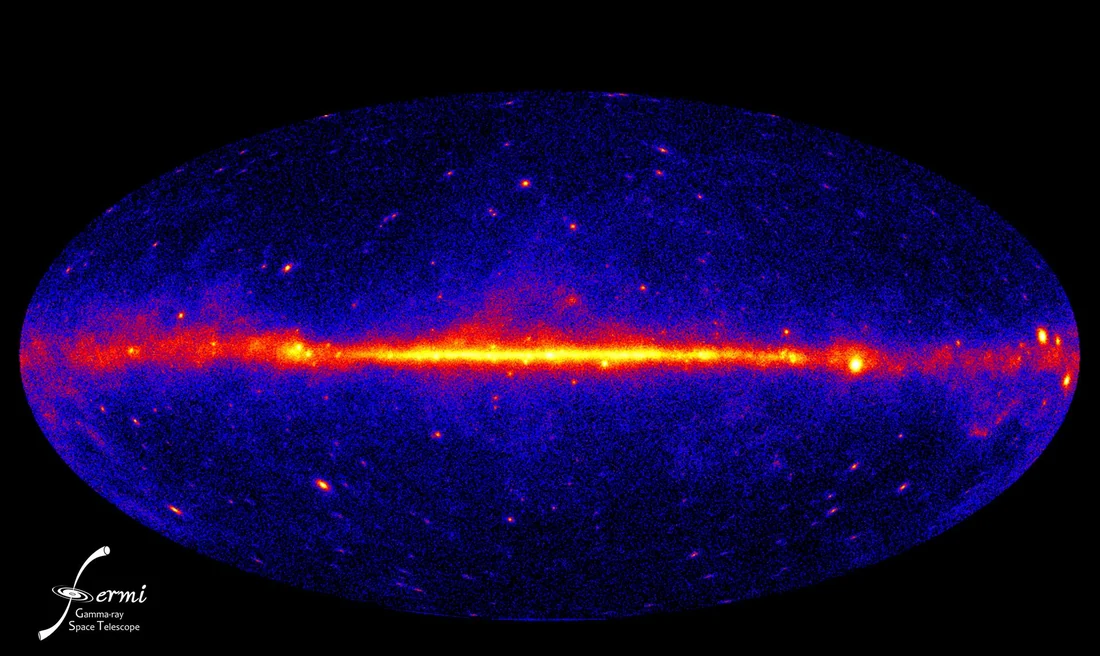
A new search finds a pulsar in 15 years of Fermi data
Astronomers detected the isolated gamma-ray pulsar PSR J1622−7204, which spins about 261 times a second. A method inspired by cryptographic research helped them find the periodic signal in sparse observations already in NASA’s public archive.
NASA/DOE/Fermi LAT Collaboration Webb helps trace a stellar merger in Andromeda
After a star spiralled into its supergiant companion, Webb observed the aftermath in infrared. Combined with earlier observations, the data let astronomers follow the system from before the 2025 eruption to the expanding dust left by the merger.
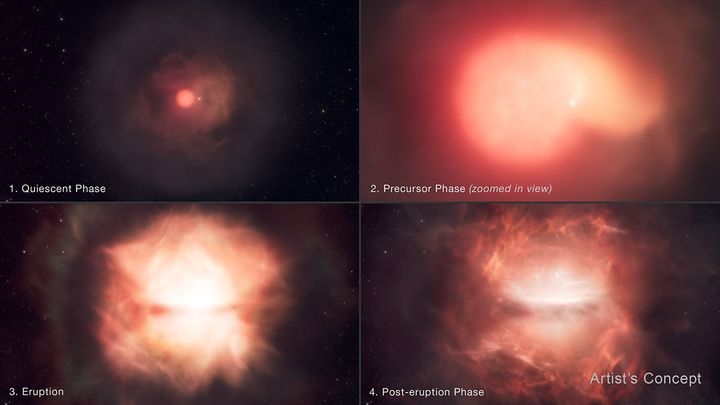
Illustration: NASA, ESA, CSA, STScI, Leah Hustak (STScI); Science: Viraj Karambelkar (Columbia) Stratospheric dust holds clues to ice beyond Neptune
Researchers examined 12 dust grains collected high above Earth. Minerals in the grains carry a signature consistent with ancient water rich in heavier oxygen isotopes, offering clues to the ice that once existed in the Kuiper Belt.
Mars Express images reveal two collapses at a Martian volcano
ESA’s Mars Express released a new view of Tharsis Tholus, an approximately eight-kilometre-high volcano on Mars. Images from its High Resolution Stereo Camera show an older outer caldera and a younger inner one. The nested depressions preserve evidence of at least two collapses, helping researchers piece together how the volcano’s summit changed over time.
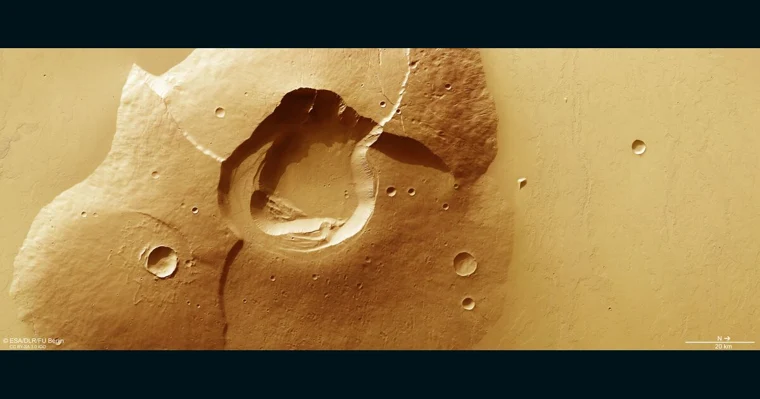
Tharsis Tholus · ESA/DLR/FU Berlin NASA schedules Roman’s first-image reveal for 7 December
The Nancy Grace Roman Space Telescope’s first images are scheduled for release on 7 December at 20:30 UTC, or 04:30 the next morning in Hong Kong.
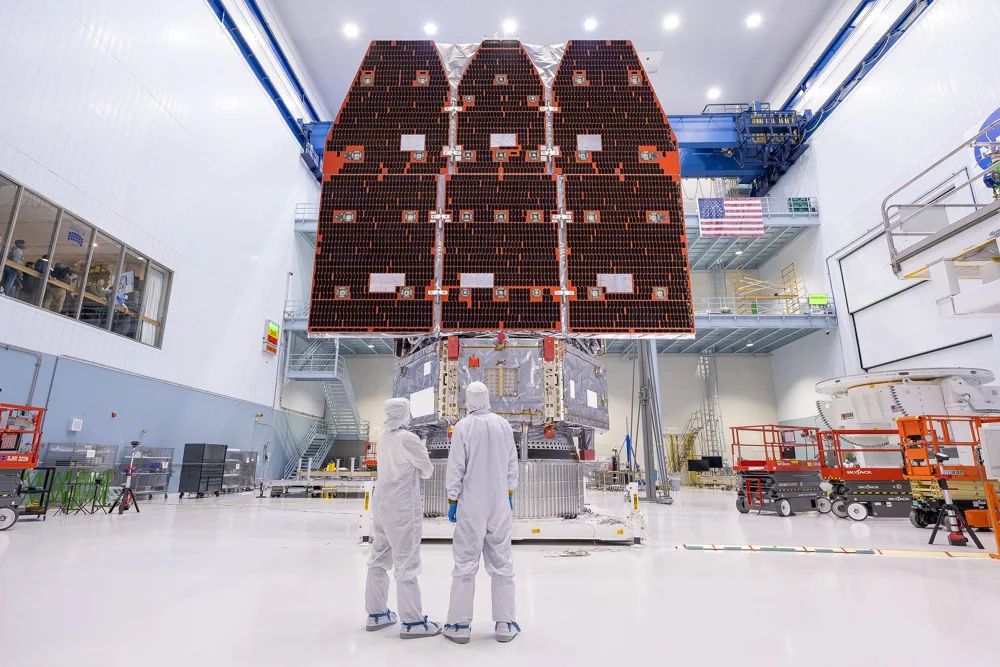
NASA/Jolearra Tshiteya Hera’s thermal camera brings Dimorphos out of shadow
Only a sliver of sunlight marked the 151-metre moonlet in reflected light. The thermal infrared image traced the whole body, including the terrain facing away from the Sun.
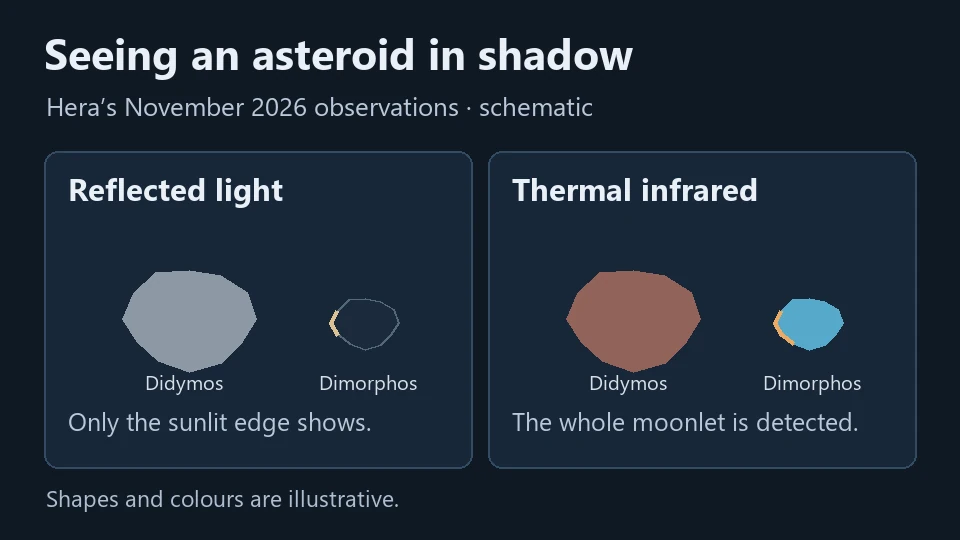
Starward Observatory Euclid releases the foundation for its 3D map
Euclid’s first major data release covers more than a billion objects and draws on about 13 months of observations. It gives researchers a starting point for charting the large-scale structure of the universe.
Two Chilean telescopes capture a nearby supernova brightening
The Dark Energy Camera and Gemini South imaged SN 2026ahvu while it was still brightening in the barred spiral galaxy NGC 1433. ATLAS first detected the object on 2 November, and spectroscopy identified it as a young Type Ia supernova. The new observations give astronomers a chance to study the early rise before peak brightness.
Webb and Gemini find a candidate quasar pair at cosmic dawn
Spectra from Webb and Gemini North show two quasar-like sources as they appeared 900 million years after the Big Bang. The spectra favour two actively feeding black holes, though gravitational lensing could still explain both images. If the pair is confirmed, it could help test how massive black holes grew so early.
Hubble traces missing oxygen in dwarf galaxies
A study of 37 nearby dwarf galaxies found that they retain only a small share of the oxygen their stars produced. Winds driven by massive stars and supernovae may have carried much of it beyond the galaxies.
November’s full Moon: what makes it look larger?
On 24 November 2026, the Moon rises in Hong Kong before sunset and reaches full phase almost six hours later. The evening offers two ways to compare how large the Moon looks.
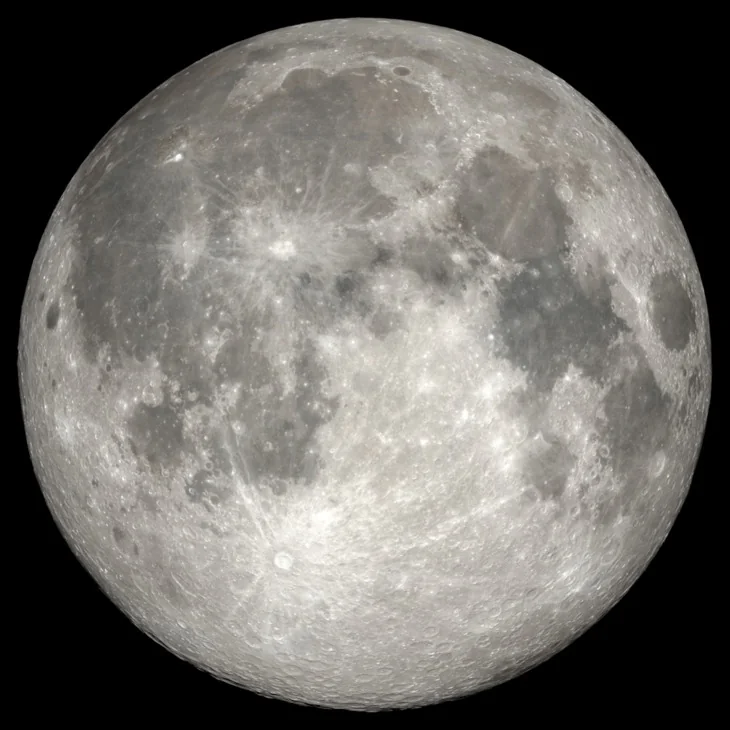
NASA Scientific Visualization Studio / Ernie Wright
October
Rubin spots two asteroids trailing Neptune
Observations from the Vera C. Rubin Observatory revealed two asteroids in stable orbits roughly 60° behind Neptune along its path around the Sun. The finds double the number of confirmed long-term members of that group from two to four.
Two debris rings circle a white dwarf
Observations from ESO’s Very Large Telescope reveal two rings separated by a gap around the white dwarf J1328−1450. The research team proposes that surviving planetary bodies could account for the gap.
Rubin spots a possible dwarf planet beyond Pluto
Rubin Observatory detected 2026 ED138 at a distance beyond Pluto’s orbit. The team combined repeated Rubin detections with archival images to trace its path. The Minor Planet Center published the observations, while the object’s dwarf-planet status remains uncertain.
Japan’s MMX spacecraft completes its first flight checks
JAXA confirmed on 21 October that its Martian Moons eXploration spacecraft had completed the critical operations that followed launch. The team will check its instruments and prepare for the journey to Mars.

Diagram: Starward Observatory · Source data: JAXA Gemini resolves chains of knots in supernova remnant Pa 30
New Gemini North images show that the radial filaments in Pa 30 are chains of compact knots rather than smooth streaks. The observations used the Gemini Multi-Object Spectrograph. Pa 30 is considered the likely remnant of a supernova seen in 1181; the finer structure gives researchers a new way to examine how the ejecta evolved.
Webb shows how young stars shape the clouds of NGC 7129
In a Webb near-infrared image, a bright cavity and clumps of shocked gas surround young stars. The contrasting structures show how stars in different stages of formation affect the same cloud.
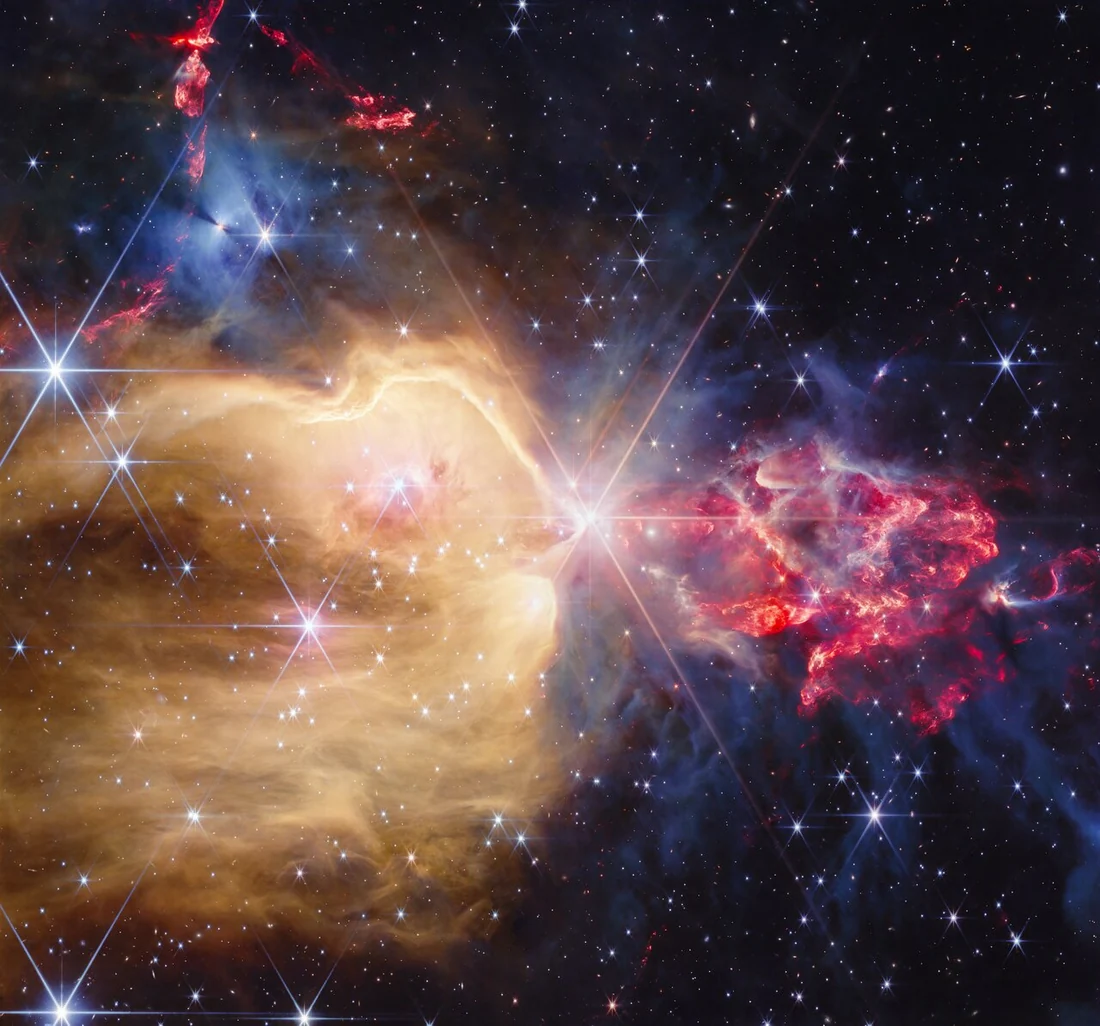
NASA, ESA, CSA, STScI; Image Processing: A. Pagan (STScI)
August
A fast star offers a new way to probe the Milky Way’s black hole
Observations with ESO’s Very Large Telescope Interferometer revealed S301, a star that reaches about 25,000 kilometres per second near the Milky Way’s central black hole. Its unusually tight orbit could let astronomers measure the black hole’s spin by tracking subtle changes in the star’s motion. That measurement has not yet been made.
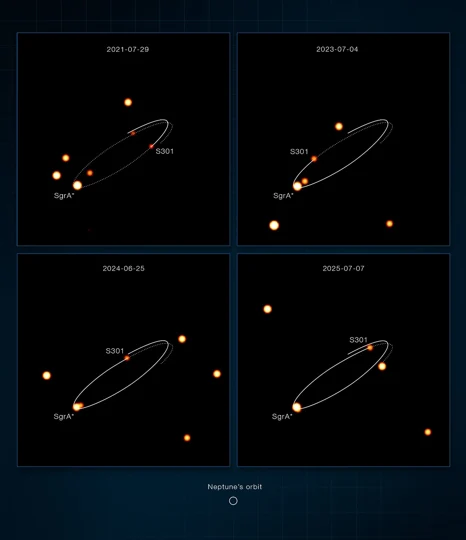
S301 · ESO/GRAVITY collaboration DESI imaging surveys release a map of nearly four billion objects
The DESI Legacy Imaging Surveys released a two-dimensional map covering about three-quarters of the sky and cataloguing nearly four billion objects. The public map combines observations from several imaging surveys. It gives researchers and the public a way to explore the same sky data and helps astronomers find targets such as strong gravitational lenses.
July
Hayabusa2 caught two laser echoes during its Torifune flyby
JAXA reported two successful laser ranges during Hayabusa2’s 5 July flyby of asteroid Torifune. The echoes, at distances of about 20 and 15 kilometres, came seconds before the spacecraft passed the asteroid.
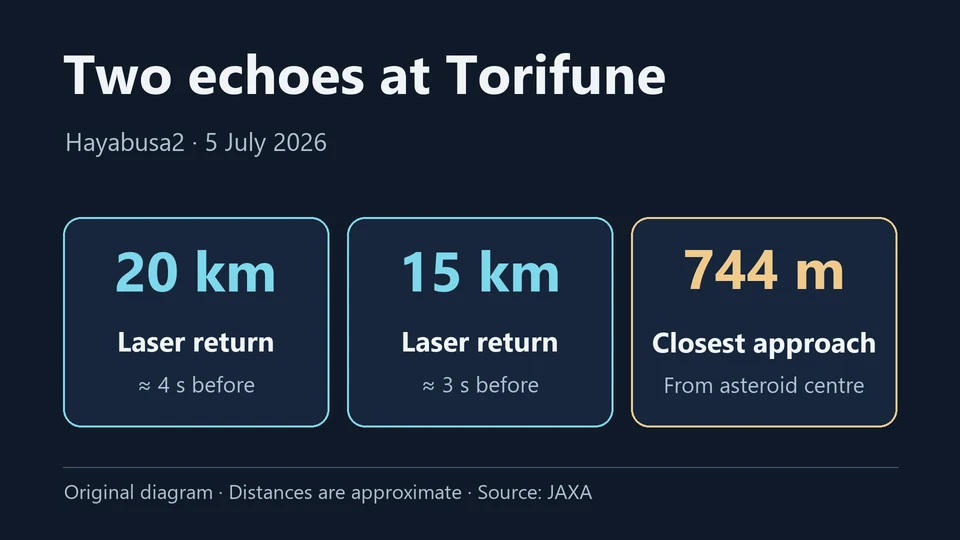
Diagram: Starward Observatory · Source data: JAXA A faint third planet emerges in images of Beta Pictoris
Astronomers using ESO’s Very Large Telescope found Beta Pictoris d, a third planet around the young star Beta Pictoris. They confirmed it in archival images spanning more than a decade. The planet is about 100 times fainter than Beta Pictoris b, showing how old observations can help verify discoveries close to a bright star.
June
Rubin Observatory begins its ten-year sky survey
Rubin Observatory has begun the ten-year Legacy Survey of Space and Time, following commissioning and the start of its alert stream. The survey will revisit the southern sky every few nights. Comparing those images over time will let astronomers track moving Solar System objects and catch brief events such as stellar explosions.
A second lunar image helps trace the tiny rover SORA-Q
A newly released camera fragment helps explain how the palm-sized SORA-Q rover moved on the Moon in January 2024. Rocks visible in two views let the team estimate that the rover moved about 13 centimetres and turned roughly 180 degrees between exposures.
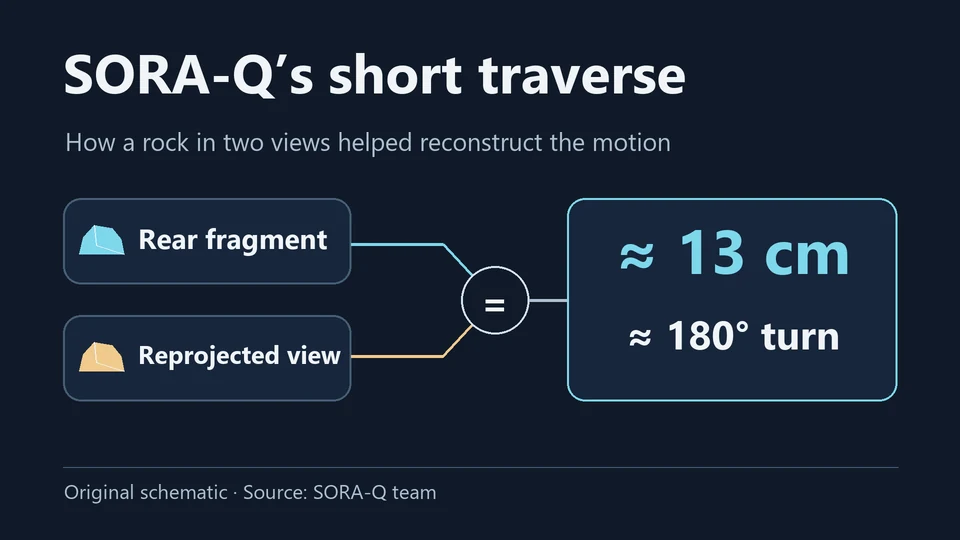
Diagram: Starward Observatory · Source data: SORA-Q mission team