A second lunar image helps trace the tiny rover SORA-Q
A newly released camera fragment helps explain how the palm-sized SORA-Q rover moved on the Moon in January 2024. Rocks visible in two views let the team estimate that the rover moved about 13 centimetres and turned roughly 180 degrees between exposures.
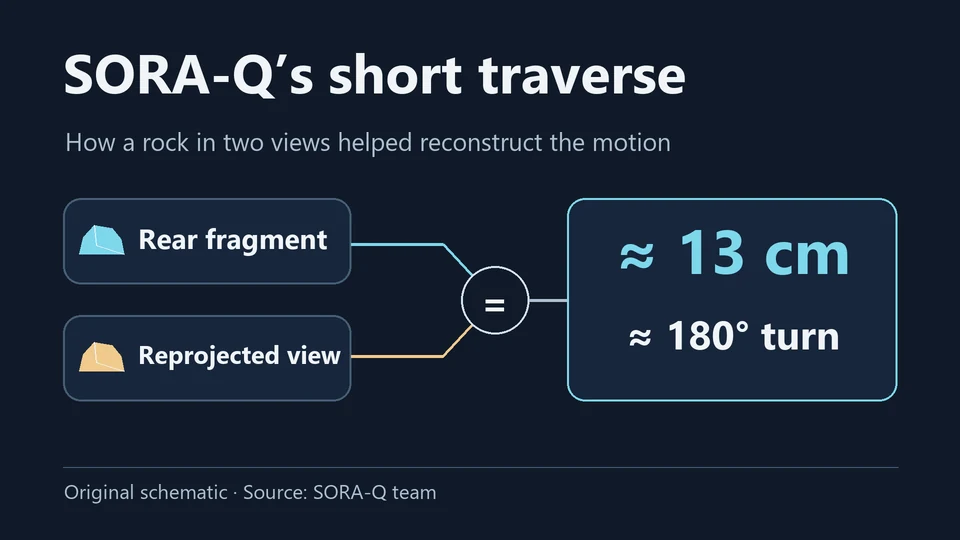
SORA-Q, formally LEV-2, touched down as part of Japan’s SLIM mission. It unfolded from a sphere roughly eight centimetres across, photographed its surroundings and transmitted data without commands from the ground. Only part of the later rear-camera frame survived transmission. Researchers reprojected the earlier front-camera image to the rear camera’s viewpoint and compared features visible in both. The study appeared in Science Robotics on 11 June Hong Kong time, and the team released the new image on 18 June.
Starward perspective
The surviving rear-camera fragment is the observation. The reprojected view is how researchers test a possible change in position and orientation. Matching a rock between them supports that estimate. The rebuilt view may also suggest what was in the area where data were lost, which remains an inference.