When is it dark enough to look for a faint object?
Put twilight, the Moon and your target on the same timeline to find the hours when a faint galaxy or nebula has the best chance of standing out.
Start with the end of astronomical twilight
The sky keeps scattering sunlight after sunset. The U.S. Naval Observatory marks the ends of evening civil, nautical and astronomical twilight when the Sun’s centre reaches −6°, −12° and −18°, respectively. For a faint galaxy or nebula, start by looking for time after −18°. Use earlier twilight to set up, find a bright guide star or observe the Moon. At high latitudes in summer, the Sun may stay above −18° all night.
Put the Moon and the target on the same clock
Use a sky chart set to your site and date. For each hour after sunset, write down the target’s altitude and azimuth and the Moon’s altitude. Cross out times when the target is behind a ridge or a building in that direction. For an unobstructed site, choose a minimum altitude that keeps the target away from the worst horizon haze. If the Moon is up, also check its phase and angular distance from your target. A bright Moon close to the target is a good reason to try another hour or night.
Try the method on Andromeda from Hong Kong
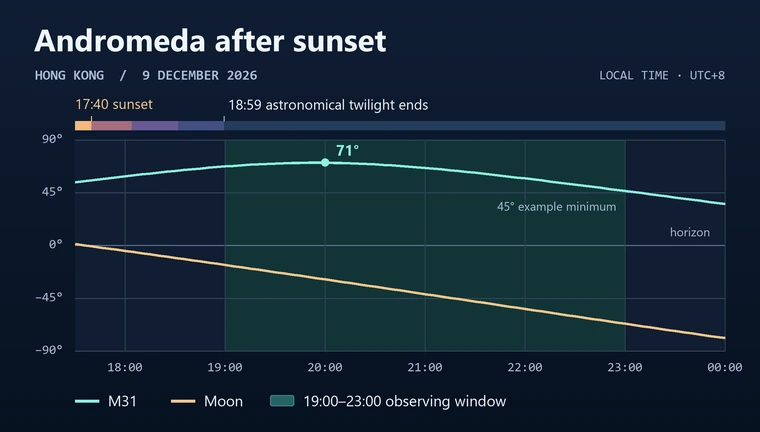
On 9 December 2026, sunset is at 17:40 and the new Moon sets at 17:42, Hong Kong time (UTC+8). Civil twilight ends at 18:04, nautical twilight around 18:32 and astronomical twilight around 18:59. From 19:00 to 23:00, the Moon is below the horizon and M31, the Andromeda Galaxy, stays above a chosen 45° minimum. It lies about 68° up in the northeast at 19:00, reaches about 71° near due north around 20:00 and drops to about 47° in the northwest by 23:00. The chart shades this four-hour window.
Choose an hour and check the view on site
Try around 20:00 in the Hong Kong example, when M31 is near its highest point. In Starward Observatory, choose Hong Kong in Telescope and enable Telescope mode, then use Pointing to track M31. Set the observatory clock to 2026-12-09 12:00:00 UTC for 20:00 locally. For your own night, look towards the target before setting up. If haze or glare washes out that part of the sky, move to a sheltered spot or use the session for a bright cluster. Under a clear, dark sky, binoculars can show M31’s bright core and a little of its elongated disc.