How did Gaia measure the distances to stars?
A nearby star seems to shift as our viewpoint moves around the Sun. Gaia used the size of that yearly shift to work out how far away the star is.
Why the viewpoint matters
Hold a finger at arm’s length and look past it towards a distant edge. Alternate between your left and right eye. The finger seems to jump against the edge, and bringing the finger closer makes the jump larger. Earth’s year-long orbit provides a much wider baseline. In the ideal case, two views from opposite sides of the Sun look across the line of sight and capture the full parallax shift. The parallax angle p is half that shift, corresponding to a baseline of one astronomical unit, roughly the Earth–Sun distance.
Separate a yearly swing from a steady drift
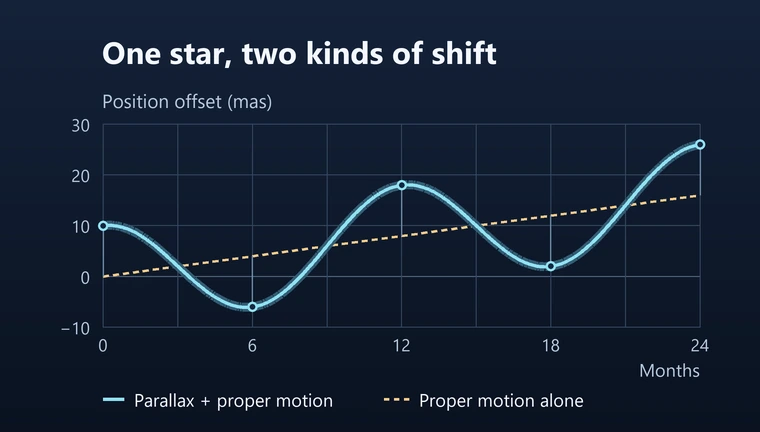
Gaia repeatedly scanned the sky while travelling around the Sun near Earth. Its team fitted the measurements at many dates using Gaia’s known position at each observation. Parallax repeats annually and its direction on the sky depends on where the observer is along the orbit. Proper motion comes from the star’s actual motion across our line of sight and usually looks like a steady drift over a few years. The plot shows just one sky coordinate in a simplified model. The solid curve combines the shifts, and the dashed line shows the drift alone. Subtract the dashed line and the same yearly pattern returns around zero.
Turn a small angle into parsecs
One parsec (pc) is the distance corresponding to a parallax of one arcsecond, about 3.26 light-years. Gaia lists angles in milliarcseconds (mas), with 1,000 mas in an arcsecond. For a well-measured parallax, the distance in parsecs is about 1,000 divided by p in mas. Say the full swing after removing the drift is 20 mas. The parallax is half of that, 10 mas, so the distance is about 100 pc, or 326 light-years.
Check how well the angle was measured
The Gaia catalogue gives each parallax an uncertainty, listed as parallax_error. Compare a hypothetical 10.0 ± 0.2 mas with 1.0 ± 0.8 mas. The first has a 2% relative uncertainty and supports a distance near 100 pc. For the second, the error is nearly as large as the angle, and dividing by a value close to zero makes the result very sensitive to noise. A catalogue estimate can even be negative when the signal is weak. For noisy measurements, astronomers use statistical distance estimates that combine the measured angle and its uncertainty with information about plausible distances.
Try reading the plot yourself
Compare the solid and dashed lines at months 0, 6 and 12. The solid line starts 10 mas above the dashed line, falls to 10 mas below it at month 6 and returns to 10 mas above it at month 12. How far away would a star be if those offsets were +5, −5 and +5 mas instead? The new parallax would be 5 mas, giving 200 pc, twice the distance in the worked example.