Measure the seasons with a noon shadow
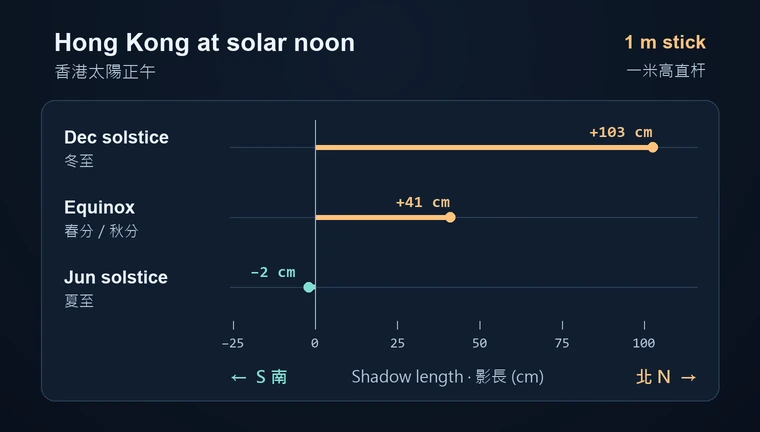
A one-metre stick in Hong Kong can cast a northward shadow longer than itself at the winter solstice. At the summer solstice the shadow is only about two centimetres long and points south.
Set a one-metre stick upright
Choose a level surface with unobstructed sunlight around noon. Secure a straight stick with 1.00 metre between the ground and its tip, and use a plumb line or spirit level to set it vertical. Mark the base and lay out a north–south reference using true north from a map or a corrected compass. Measure along the ground from the base to the middle of the shadow’s fuzzy tip, and write down the direction. Keep your eyes on the ground while you work.
Find solar noon on each date
Use the Hong Kong Observatory’s Sun Transit table for the date and start taking readings a few minutes either side of the tabulated time. Take the length and direction closest to transit. Solar noon is when the Sun crosses your local meridian, which is usually a different time from 12:00 on the clock. In 2026, the Observatory gives transit at 12:31 HKT on 20 March (spring equinox), 12:25 on 21 June (summer solstice), 12:16 on 23 September (autumn equinox), and 12:22 on 22 December (winter solstice). These are transit times on the listed dates. The equinox and solstice themselves have their own times. Check the tables for your year.
Calculate the altitude and keep the sign
Use latitude φ = +22.3° for Hong Kong and declination δ, the Sun’s angular position north or south of Earth’s equator projected onto the sky. Take δ ≈ −23.44° at the December solstice, 0° at either equinox and +23.44° at the June solstice. Subtract δ from φ to get the signed angle z = φ − δ. Solar altitude above the horizon at transit is 90° − |z|. Positive z puts the Sun south of overhead and the shadow north. Negative z puts the Sun north of overhead and the shadow south.
Check the length as well as the direction
Set your calculator to degrees. For a one-metre stick, 100 × tan(z) gives the signed shadow length in centimetres, with north positive. The December solstice gives z ≈ +45.74°, altitude 44.3° and about 103 cm north. Either equinox gives z ≈ +22.3°, altitude 67.7° and about 41 cm north. The June solstice gives z ≈ −1.14°, altitude 88.9° and about 2 cm south. These are model values for level ground, a vertical stick and the centre of the Sun’s disk. A slight tilt of the stick or a fuzzy shadow edge matters most for the very short June reading.
Connect the shadow to Earth’s tilt
As Earth orbits, its tilted axis changes the angle of sunlight and the length of daylight at your site. In Hong Kong the June Sun climbs higher and the daylight lasts longer than in December. At the June solstice the latitude where the Sun is directly overhead reaches about 23.44° N, north of Hong Kong. That is why the local noon shadow points south for several weeks around the June solstice. If clouds interrupt the exercise, use a nearby clear day and record the actual date. The shadow changes more slowly near the solstices than near the equinoxes.