What do the planets mean in Western astrology?
Mercury is associated with thinking and communication, Venus with attraction and values, and Mars with taking action. Learn what each body represents and how to combine it with a sign and a house.
Read with discretion. Astrological interpretations of personality and houses are symbolic traditions. Astrology is not an exact science.
The Sun, Moon and Earth
The Sun and Moon are the two luminaries. The Sun symbolises identity, vitality and purpose. The Moon symbolises emotional responses, habits and what feels familiar or reassuring. Astrologers often include both under the heading ‘planets’. Astronomy classifies the Sun as a star and the Moon as Earth's natural satellite. A standard birth chart uses an Earth-centred view for the bodies' zodiac positions and the birth location to orient the chart. Earth provides the reference point, so it does not normally appear as a separate placement.
Mercury · Thinking and communication
Mercury covers how you take in information, make connections and put ideas into words. Comparing two accounts of the same event, asking for clarification and explaining what you found are all examples of Mercury themes.
Venus · Attraction and values
Venus concerns what you enjoy, what you value and how you build rapport. Its themes include affection, taste, pleasure and the give-and-take of relationships. Choosing a piece of music or finding a compromise with a friend are everyday examples.
Mars · Action and assertion
Mars is associated with drive, initiative, anger and conflict. Starting a task, speaking up in a disagreement and defending a boundary are different ways to explore its themes.
Jupiter · Growth and perspective
Jupiter is associated with widening horizons through learning, opportunity, beliefs or the search for meaning. Its symbolism also includes excess. Taking on a bigger project and taking on more than you can manage both fit the theme of expansion.
Saturn · Limits and responsibility
Saturn concerns structure, commitments and the work that takes time. Think of sticking to a practice schedule, setting realistic limits or building a skill through repetition.
Uranus · Independence and disruption
Modern astrologers associate Uranus with experimentation, freedom and breaks from established patterns. Trying an unconventional approach and having to rethink an outdated rule both illustrate this symbolism.
Neptune · Imagination and uncertainty
Neptune is associated with dreams, ideals, imagination and blurred boundaries. The same image can suggest creative inspiration or raise questions about where hopes outrun the available evidence.
Pluto · Power and transformation
Modern astrological readings use Pluto to discuss control, hidden dynamics and changes that go deeper than a surface adjustment. In astronomy, Pluto is a dwarf planet under the International Astronomical Union's 2006 definition. It orbits the Sun and is nearly round, but has not cleared its orbital neighbourhood.
The classical seven and the modern outer planets
Traditional Western astrology works with seven classical bodies. They are the Sun, Moon, Mercury, Venus, Mars, Jupiter and Saturn. Many modern Western astrologers also read Uranus, Neptune and Pluto, discovered in 1781, 1846 and 1930 respectively. In this astrological grouping, the three are often called the outer or generational planets because each stays in a sign for years. Many people born in the same period share those signs, so readers also look at the house and aspects before interpreting an individual's placement.
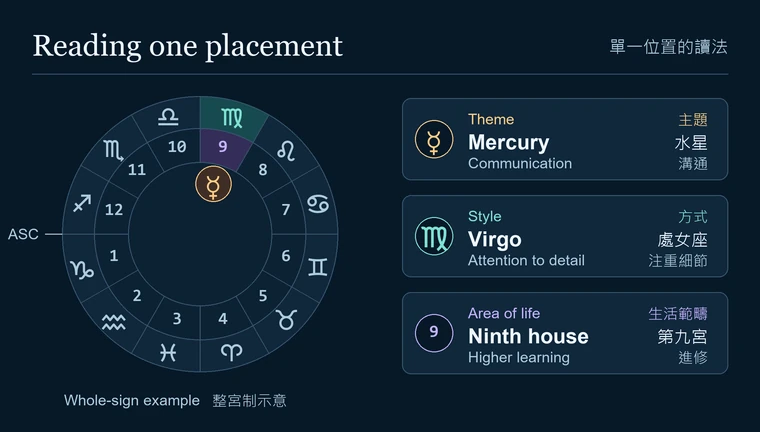
Read Mercury in Virgo in the ninth house
In this fictional whole-sign chart, Capricorn is the rising sign and therefore the first house. Count forward through the signs to Virgo, the ninth house, where Mercury is marked. Start with the body to identify the theme. Mercury points to thinking and communication. Use the sign for the style. Virgo suggests attention to detail and sorting information. Use the house for the area of life. The ninth includes higher learning and worldviews. Put them together as a question you could explore. When you encounter a new idea in a course, how do you check its sources and explain what you learned? In Starward Observatory, open Tools → Astrology and choose one row under Positions and angles to try the same three steps. The chart calculates where each body appears. The meanings here belong to an interpretive tradition and have no established scientific power to predict personality or events.